
Policy White Paper: Beyond Aid
Rethinking Development for a Changing World
Executive Summary
The global system for financing social and economic progress is under mounting strain and no longer matches the scale or complexity of today’s challenges. Official development assistance from OECD-DAC members has fallen by 23.1 percent in 2025, the steepest drop on record, and political and fiscal pressures are reshaping how and where resources are allocated. The question is no longer whether higher foreign aid budgets on their own can close the distance between ambition and delivery, but how we design a financing architecture that can actually match the scale and complexity of today’s development challenges.
Against this backdrop, the paper argues that the development finance architecture suffers from two fundamental flaws: an over reliance on foreign aid, and a structural misalignment between where vast pools of capital are concentrated and the local actors best placed to deliver change. Among those local actors, women's rights organizations (WROs) stand out. WROs are frontline first responders to some of the world’s most complex challenges; from climate resilience, to conflict mitigation, and democratic resilience, yet they remain chronically under-resourced, a striking example of a system that rewards process over impact. Closing that gap is not a matter of charity or moral preference, but something – as the IMF puts it – that is “macro critical” , with clear implications for growth, stability, and long-term returns.
The paper is organized around three propositions.
- Section 1 sets out the development financing gap and why restoring past levels of foreign aid alone cannot fix it. The system needs new models that connect public, philanthropic, and private capital to reduce dependency on annual donor cycles and mobilize institutional capital without losing accountability to real world outcomes.
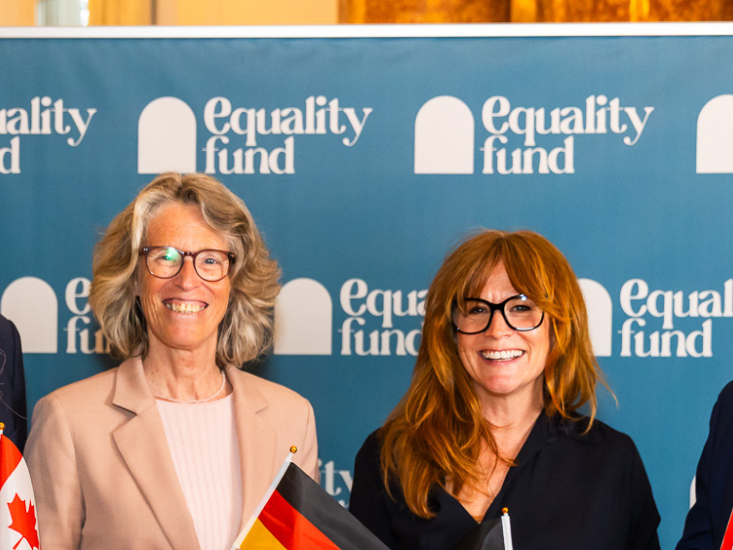
- Section 2 presents Equality Fund, a hybrid pooled fund and endowment platform. Seeded by a landmark CAD $300 million commitment from the Government of Canada in 2019, it is one of the most advanced and proven examples of a future-fit, innovative development finance model. Having catalyzed further bilateral and philanthropic money from its initial seed capital, it has already disbursed more than CAD$125 million to over 1,800 WROs in 100 countries, and utilizes a robust gender-lens investing approach.
- Section 3 diagnoses the structural barriers that keep capital from flowing at scale: the limited recognition of gender equality as a macro-critical priority; fragmented markets that constrain gender-lens investing; and a lack of strategic investment to drive transformation - leaving gender equality to be treated as a niche rather than a material driver of returns and risk. Alongside each barrier are recommendations, intended to drive systemic change - changes to rules, incentives, and infrastructure - rather than ad-hoc, one-off commitments. These are targeted at governments, multilaterals and development finance institutions - those with the power and influence to drive genuine change across the system. The Equality Fund shows that a different model is possible. What is needed now is the political will and market discipline to make it the norm rather than the exception.
 Read the white paper